
Search Minneapolis Police Records
Minneapolis police records are public documents maintained by the Minneapolis Police Department under the Minnesota Government Data Practices Act. Residents, attorneys, and researchers can request arrest logs, incident reports, and other law enforcement data from the department's Records Unit at 505 Fourth Ave. S. The city follows state law on what it must release and what it can hold back, and most basic arrest data is open to anyone who asks. This guide walks through how to request records, what you can expect to find, and how to use state and court systems to search criminal history data for the Minneapolis area.
Minneapolis Overview
Minneapolis Police Department
The Minneapolis Police Department (MPD) handles law enforcement for the city and maintains records on arrests, incidents, calls for service, and use of force. The department's Records Unit is the main point of contact for public data requests. You can visit in person, submit a request by mail, or use the city's online data request system.
- Records Unit Address: 505 Fourth Ave. S., Minneapolis, MN 55415
- Hours: Monday through Thursday, 8 a.m. to 4 p.m.; Friday, 9 a.m. to 4 p.m.
- Non-Emergency Phone: (612) 673-3000
- Website: www.minneapolis.gov/police
The Records Unit processes requests for police reports, arrest records, incident logs, and other law enforcement data. Staff can tell you what is public and what falls under active investigation exemptions. If a record is restricted, they will generally note that a record exists but cannot be released in full.
How to Request Minneapolis Police Records
There are three main ways to request records from the MPD.
In Person
Visit the Records Unit at 505 Fourth Ave. S. during business hours. Bring a photo ID. If you are requesting your own records as the data subject, you may have broader access rights under Minn. Stat. 13.04. Staff can help you fill out a request form on site.
By Mail
Send a written request to the Records Unit address above. Include your name, the type of record you need, relevant dates or case numbers if you have them, and a copy of your ID if you are requesting your own data. Mail requests typically take longer than in-person visits.
Online
Minneapolis has an online public data request portal. Go to the city's data practices page at minneapolismn.gov, select the type of record you need, and submit the form. You can track the status of your request through the portal. This option works well for people who cannot visit in person.
The city's fee policy follows state law with some local additions. Under Minn. Stat. 13.03, you have the right to inspect records at no charge. Physical copies cost $0.25 per page up to 100 pages. Minneapolis only charges for requests that cost more than $30 to fulfill; if the work takes less than that, no fee applies. For larger requests, the city bills at $30 per hour for staff time. Digital copies on CD cost $1.00; flash drives run $5 for 4-8 GB or $10 for 16-32 GB.
Minneapolis Data Fees
The city posts its full fee schedule online. The page below shows current rates for copies, digital media, and staff time charges that apply to all city departments, including the police.
The fee schedule is available at minneapolismn.gov/government/government-data/request-public-data/data-fees/. Note that inspection of records is always free -- you only pay if you want physical or digital copies made.
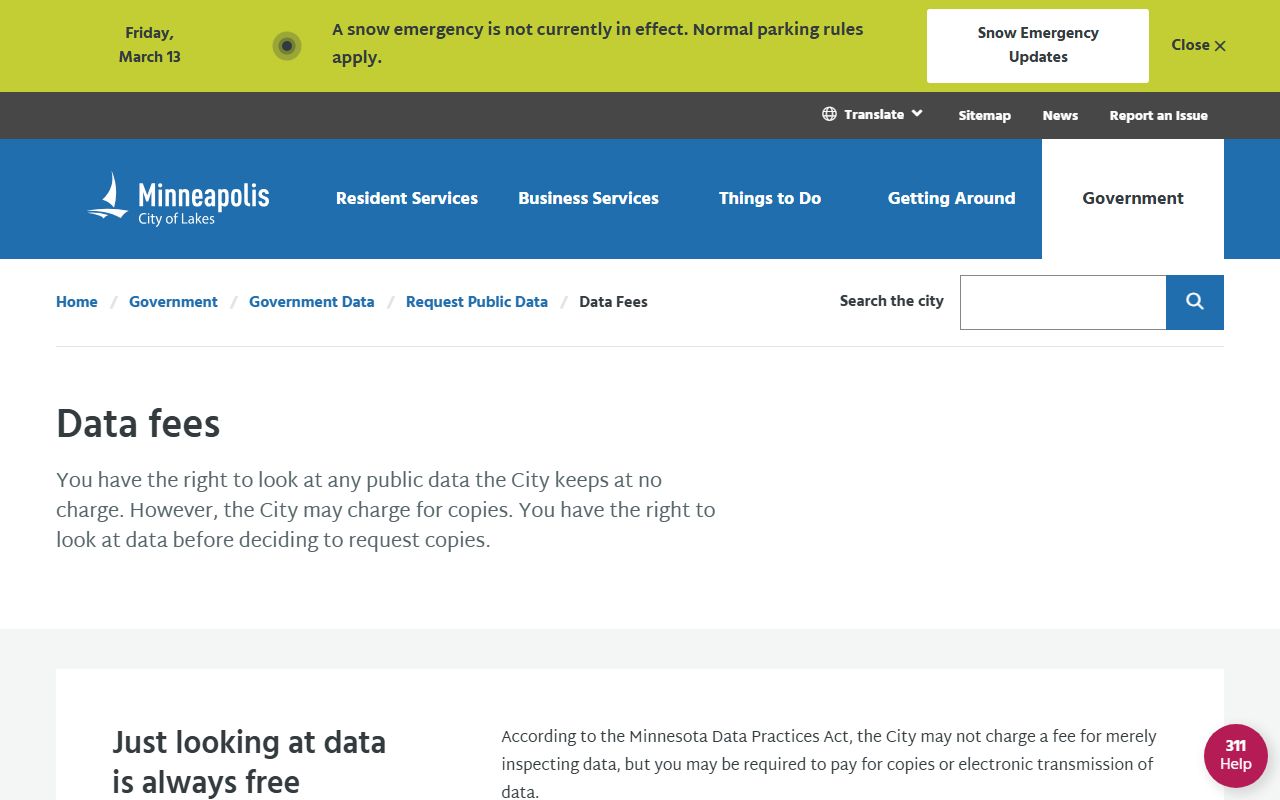
The fee page is maintained by the city's Information Officer and is updated when rates change. If your request is small, there is a good chance you will pay nothing at all.
What Minneapolis Police Records Contain
Minnesota law is specific about what law enforcement agencies must make public. Under Minn. Stat. 13.82, the following data is public for any arrest or detention:
- Full name of the person arrested
- Age, sex, and last known address
- The charge or charges filed
- Date, time, and location of the arrest
- Booking photos (also called mugshots)
- Whether the person was released or held
Incident reports often contain more detail, including names of witnesses, narrative descriptions of what occurred, and officer names. However, certain parts of a report may be redacted if they relate to an ongoing investigation, identify a juvenile, or fall under a specific data privacy exemption. The statute is clear: once a case is closed or charges are filed, most of the underlying report becomes public.
Active investigation data is confidential while the investigation is open. This means you may not be able to get a full report right after an incident. Once the case is closed or referred for prosecution, the data classification can change and more of the record becomes accessible.
Minneapolis City Website
The city's main website is a starting point for finding department contact pages, online request portals, and policy documents related to police data practices.
From the homepage, navigate to the Government section and then to Government Data to find all data request options, including police records, fire records, and city administrative files.
Online Court Records: MCRO
If you want to look up court cases tied to Minneapolis arrests, the Minnesota Court Records Online (MCRO) system is free to use. Go to publicaccess.courts.state.mn.us and search by name, case number, or date range. MCRO covers all district courts in Minnesota, including the 4th Judicial District, which serves Hennepin County.
MCRO shows case filings, charges, hearing dates, and dispositions. It does not show full police reports, but it will confirm whether a case was filed and what happened in court. This is useful if you know someone was arrested but want to know the outcome of the case. You can search MCRO at no cost; some detailed documents may require a fee to print at the courthouse.
The 4th Judicial District courthouse in Minneapolis is located at the Hennepin County Government Center, 300 South Sixth Street. Court staff can help pull records that are not yet online.
Criminal History Records and BCA Checks
The Minnesota Bureau of Criminal Apprehension (BCA) maintains statewide criminal history records for all arrests and convictions processed in Minnesota. These records go beyond a single city's arrest log and include data from courts and law enforcement agencies across the state.
Under Minn. Stat. 13.87, criminal history data is generally private. However, the subject of the record can access their own file. Employers and certain licensed agencies can request records under specific legal conditions. The BCA handles these requests separately from local police departments.
To request a background check or criminal history record through the BCA, call 651-793-2400, option 7, or visit the BCA background checks page. The BCA processes both name-based and fingerprint-based checks. Fingerprint-based checks are more thorough and less likely to return false positives from name matches.
Your Rights Under the MGDPA
The Minnesota Government Data Practices Act gives residents clear rights when it comes to public records. Minn. Stat. 13.025 sets out the basic framework for data classification and access. Under Minn. Stat. 13.03, you have the right to ask any government entity for access to public data at no charge for inspection. Copies cost a small per-page fee.
If you are the subject of the data -- meaning the records are about you -- you have additional rights under Minn. Stat. 13.04. The agency must tell you what data it holds on you, how it uses that data, and who else can see it. You also have the right to challenge data you believe is incorrect. Minneapolis police records fall under all of these provisions.
If a request is denied, the agency must give a reason. You can appeal to the Minnesota Department of Administration, which has an Information Policy Analysis Division that handles disputes over data access. Most denials come down to active investigation exemptions or data that is classified as private under a specific statute.
Other Sources for Minneapolis Crime Data
The MPD publishes its own crime data reports online. These include monthly crime statistics, use of force reports, and officer-involved shooting summaries. These are aggregate data documents, not individual records, but they give useful context about crime trends in the city.
The city also participates in the FBI's Uniform Crime Reporting program, and aggregate data from Minneapolis is available through the FBI's Crime Data Explorer. This is useful for comparing Minneapolis crime rates to national or state averages. None of this data identifies individuals -- it is all aggregate reporting.
For specific incidents that made the news, local media archives can be a good secondary source. The Minneapolis Star Tribune maintains a searchable archive. Court documents filed in connection with high-profile cases are often more detailed than police reports and may be available through MCRO or at the Hennepin County courthouse.
Hennepin County Police Records
Minneapolis sits within Hennepin County, which also processes court records and maintains records for other law enforcement agencies in the county. The Hennepin County District Court, 4th Judicial District, handles all criminal cases filed in Minneapolis. County-level records can supplement city police data, especially for cases that went to trial or involved multiple agencies.
Nearby Cities
Other qualifying Minnesota cities near Minneapolis also have police records pages with local department contact information and request procedures.