
Search Minnesota Police Records
Minnesota police records include arrest data, incident reports, and criminal history kept by county sheriffs and local police departments across all 87 counties. To search these records, you contact the agency that created them or use the state’s free online tools. The Minnesota Bureau of Criminal Apprehension maintains a central criminal history system. Minnesota Court Records Online gives public access to district court case data. The Minnesota Government Data Practices Act gives you the right to view and copy most law enforcement records held by any agency in the state.
Minnesota Police Records Overview
What Minnesota Police Records Include
Minnesota police records are official documents created when law enforcement agencies respond to calls, make arrests, or work cases. County sheriffs and city police departments both keep these records. They go by several names: police reports, incident reports, arrest records, and criminal history data. The term used depends on the type of event and the agency that created the file.
State law sets out exactly what data is public. The following information must always be available at the agency that created it: the time, date, and place of any law enforcement action; the name, age, sex, and last known address of any adult who was cited, arrested, or substantially deprived of liberty; the charge or legal basis for any arrest; whether weapons were used; any resistance or pursuit; and the response or incident report number. Booking photographs are also public data in most situations. An agency can hold a booking photo back temporarily if releasing it would hurt an active investigation, but that hold must end when the case closes.
Not all data is open. Active criminal investigations are classified as confidential or protected nonpublic data while the case is open. That data becomes public after the case goes inactive, meaning the agency stops pursuing it, the time to file charges runs out, or all appeals end. Data that would reveal the identity of an undercover officer, a victim of certain crimes, a confidential informant, or a juvenile witness may be withheld. Any investigative data that ends up as evidence in court becomes public at that point.
The Minnesota Legislature first passed this framework to make basic law enforcement activity transparent while protecting active investigations and vulnerable individuals. The right to know who was arrested, why, and what the agency did about it is a core part of the law.
The Minnesota Statute 13.82 page at the state revisor's office shows the full text of the law that governs what law enforcement data agencies must release.
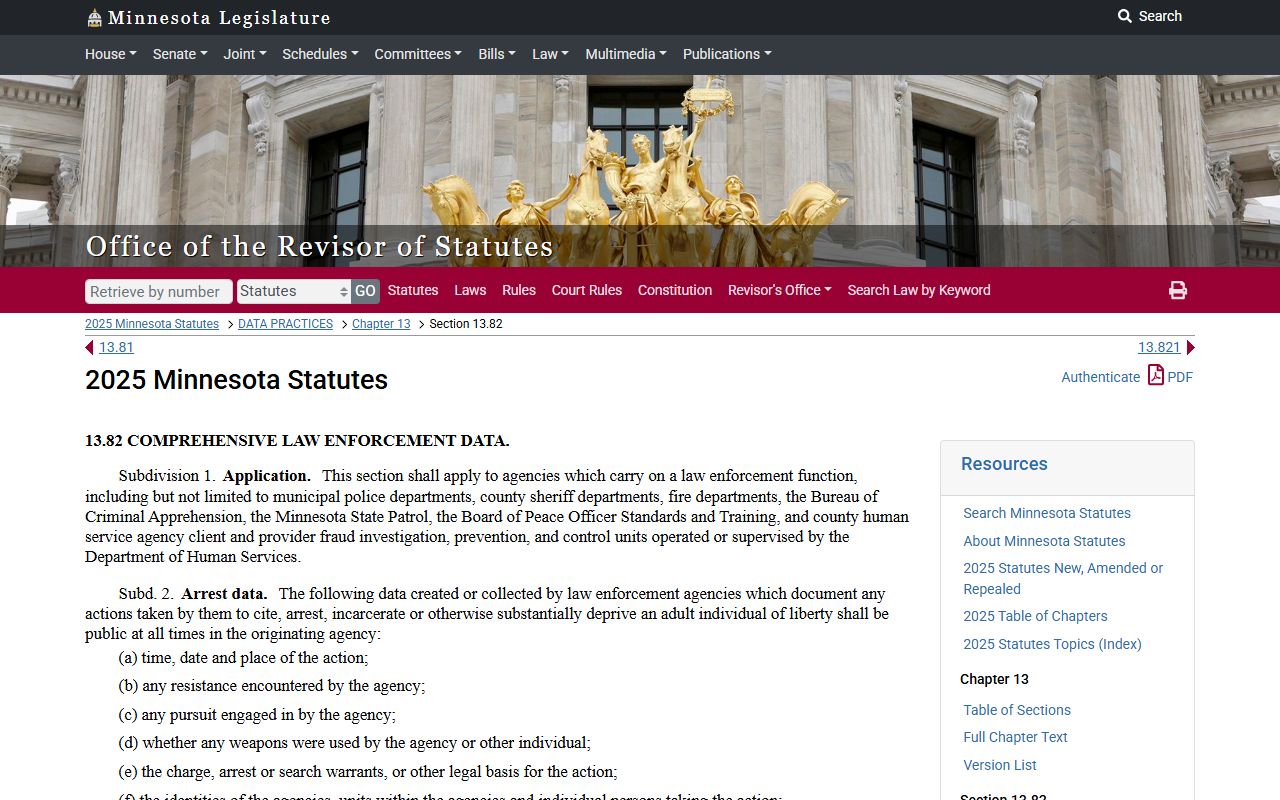
Subdivision 2 of the statute lists the specific elements of arrest data that are always public. Subdivision 6 covers response and incident data.
Note: Domestic abuse police records and related arrest data must be released at no charge to the victim, the victim's attorney, or a designated victim services organization under subdivision 5 of the same statute.
How to Get Police Records in Minnesota
To get police records in Minnesota, you contact the agency that created them. Most requests go to the county Sheriff's Office or the local city police department. You can ask in person, by mail, or through any online portal the agency offers. Some larger agencies have dedicated records units with set hours. Smaller agencies may handle requests through the front desk.
The right to inspect public data is free. Agencies cannot charge you just to look at records. If you want copies, the agency may charge up to 25 cents per page for black and white paper copies when the request is 100 pages or fewer. For larger requests, the fee covers actual cost. Electronic copies are also subject to actual-cost fees. You can look at data before deciding whether to pay for copies, which lets you narrow down what you actually need.
Response times depend on who is asking. If you are the subject of the data, the agency must respond within 10 business days. For all other requests, agencies can take up to 30 business days to process the request. Many agencies respond faster for straightforward requests. If an agency denies your request, it must give you a written denial that cites the specific statute that allows withholding the data. You can challenge that denial in district court if you believe it was wrong.
The access rules that apply statewide come from Minnesota Statute 13.03, which is the core public data access statute under the Minnesota Government Data Practices Act.
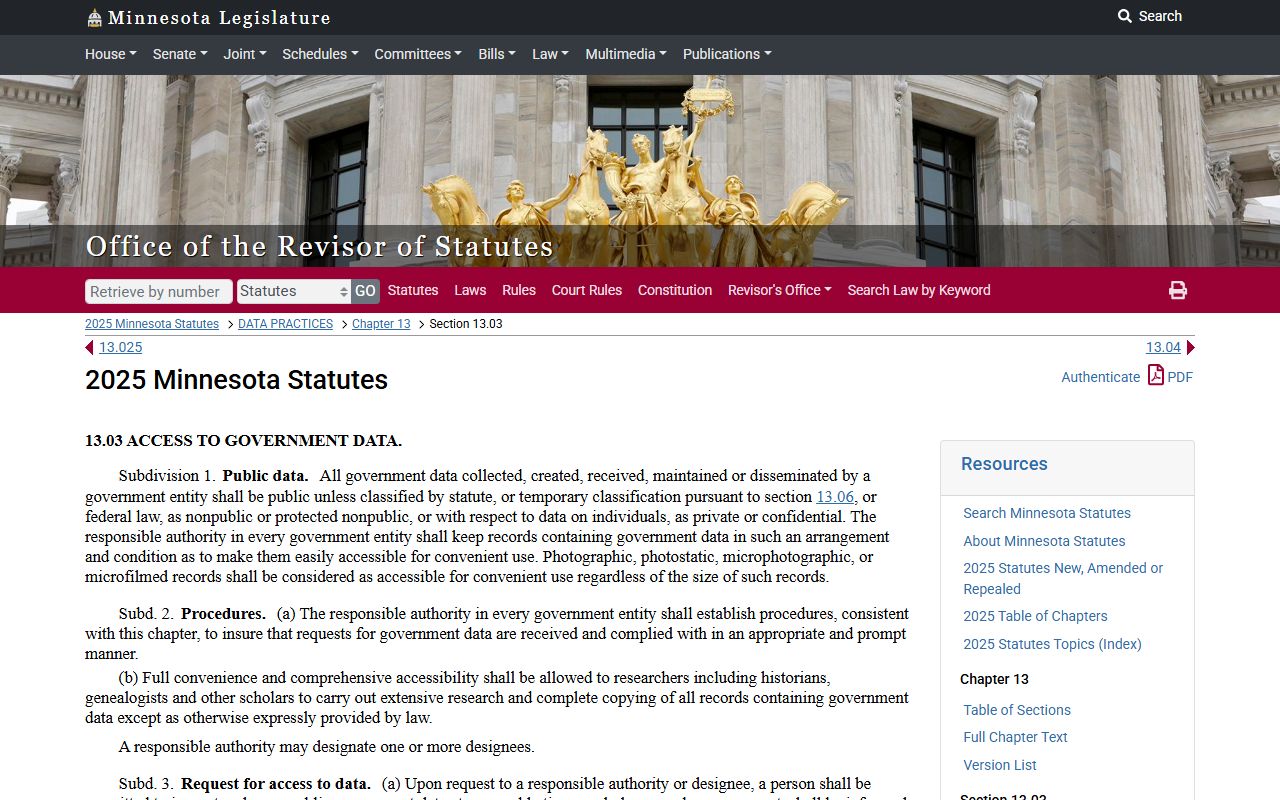
The statute makes clear that inspection is always free and that fees apply only when copies are made or data is transmitted electronically.
Note: You do not have to give a reason for requesting public data, and you do not have to be a Minnesota resident to make a request under state law.
Minnesota Bureau of Criminal Apprehension
The Minnesota Bureau of Criminal Apprehension, known as the BCA, is the state’s central law enforcement agency. It operates under the Department of Public Safety and runs the Minnesota Criminal History System. When any law enforcement agency in the state makes an arrest, that record flows into the BCA’s central system. The BCA serves as the official repository for criminal history data across all 87 counties.
The BCA handles background checks for different groups. The public can request certain checks. Employers and organizations that work with children, the elderly, or people with disabilities can request checks authorized by state or federal statute. Law enforcement agencies use the system for their own purposes. Each type of background check uses a different form and may have a different fee. When the BCA gets a request, staff check the Minnesota Criminal History System and, when authorized, also check FBI records.
For background check questions, call the BCA at 651-793-2400 and select option 7. Their main website at dps.mn.gov/divisions/bca has the forms, fee schedules, and instructions for each background check type.
The BCA homepage links to the background check portal, criminal history data resources, and contact information for each division.
The BCA also supports local agencies with investigations, forensic services, and training.
The background checks page explains the types available and who qualifies for each. The BCA background checks page lists every category and links to the forms you need.
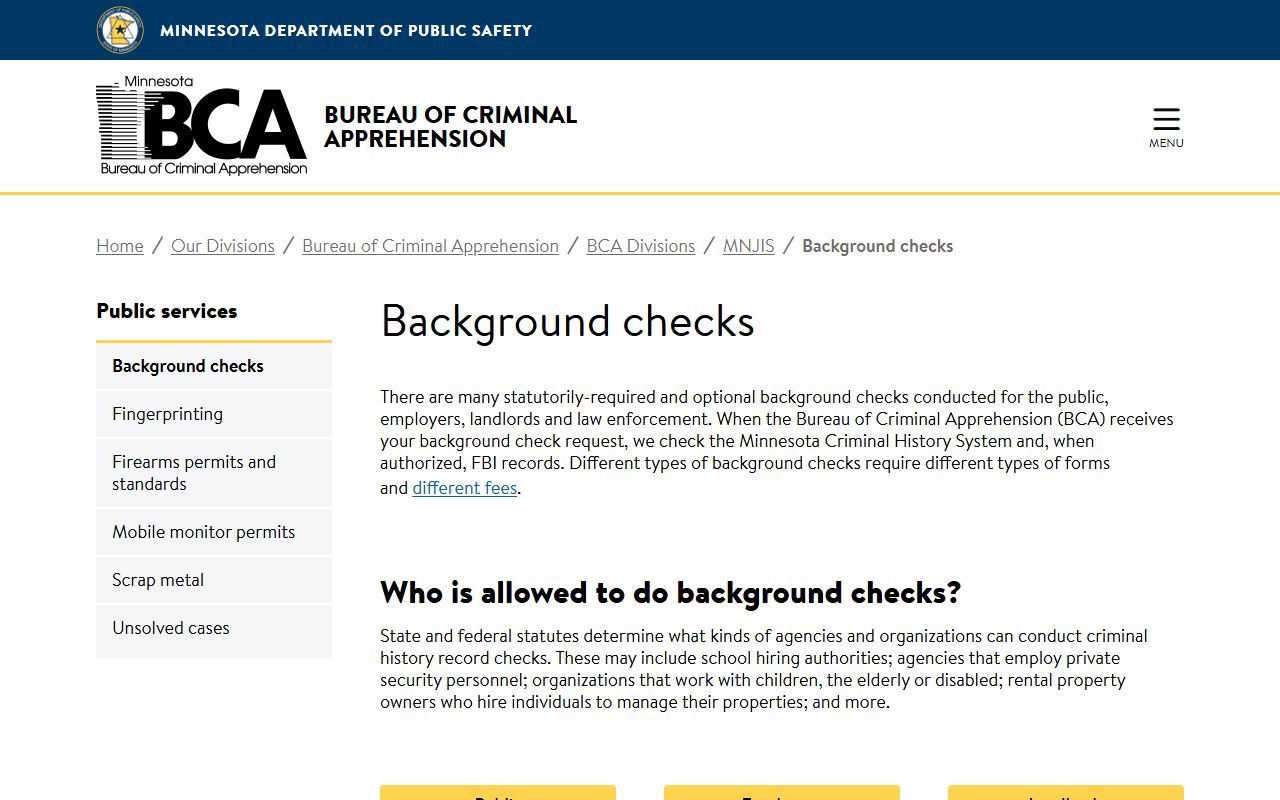
Different check types are required by different statutes, and each comes with its own process.
Search Police Records Online Through MCRO
Minnesota Court Records Online, called MCRO, gives free public access to district court case data for all 87 counties. You can find it at publicaccess.courts.state.mn.us. The system is useful when you need to search for cases tied to an arrest or find out whether charges were filed after an incident report.
MCRO has four main search tools. Case Search lets you look up cases by person name, business name, attorney name, case number, or citation number. Document Search finds filed court documents in specific cases. Hearing Search shows scheduled court dates and times. Judgment Search lets you look up money judgments by debtor name and see any payments recorded against them. Documents filed on or after July 1, 2015 are available online for most case types. Older records may need a courthouse visit.
The Minnesota Court Records Online system is the state’s official public access tool for district court records, free to use with no login required for most searches.
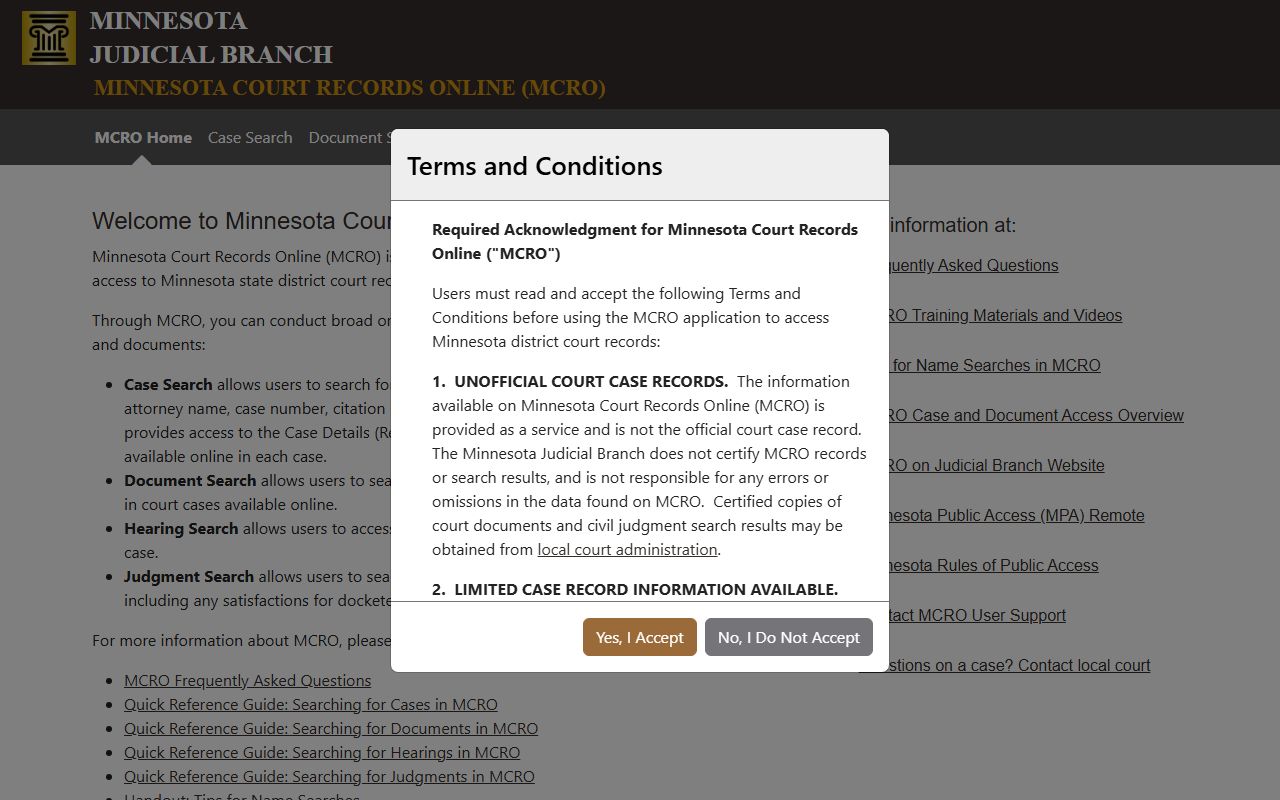
The system runs scheduled maintenance on Sundays from 9 a.m. to 4 p.m., so plan your search for another time if access is down.
Law Enforcement Police Records Data: Statute 13.82
Minnesota Statute 13.82 is the main state law governing what law enforcement agencies must release. It applies to municipal police departments, county sheriff offices, the BCA, the State Patrol, fire departments, and any other agency that carries out a law enforcement function in Minnesota. This statute creates specific categories of data and assigns each one a classification.
Three types of data are always public under this statute. Arrest data covers the core facts about any arrest: the time, date, and place; whether there was resistance or a pursuit; whether weapons were used; the charge or legal basis; who was arrested (name, age, sex, and last known address for adults); and where the person is being held. Request for service data covers calls from the public for help: the nature of the complaint, the caller’s name and address if not protected, the time and date, and the response number. Response or incident data covers what the agency did: who responded, what happened in brief factual terms, names and addresses of witnesses and victims unless protected, and whether the agency used recording equipment.
The law also addresses 911 call recordings. The audio of a 911 call is private data about the caller. But a written transcript of that same call is public. If you want the transcript, you pay the actual cost of transcribing the call plus any applicable copy fees. The audio can be used for training and investigation by law enforcement, but it is not released to the general public.
Agencies can temporarily hold back response and incident data under subdivision 14 if they reasonably believe that releasing it would endanger someone or help a suspect flee or destroy evidence. Any person can go to district court to challenge that decision. The court reviews the withheld data and can order its release if the agency acted unreasonably.
Note: The Department of Public Safety homepage at dps.mn.gov provides links to all divisions, including the BCA, State Patrol, and other law enforcement agencies that create police records in Minnesota.
The Minnesota Department of Public Safety oversees several agencies that create and maintain police records across the state.
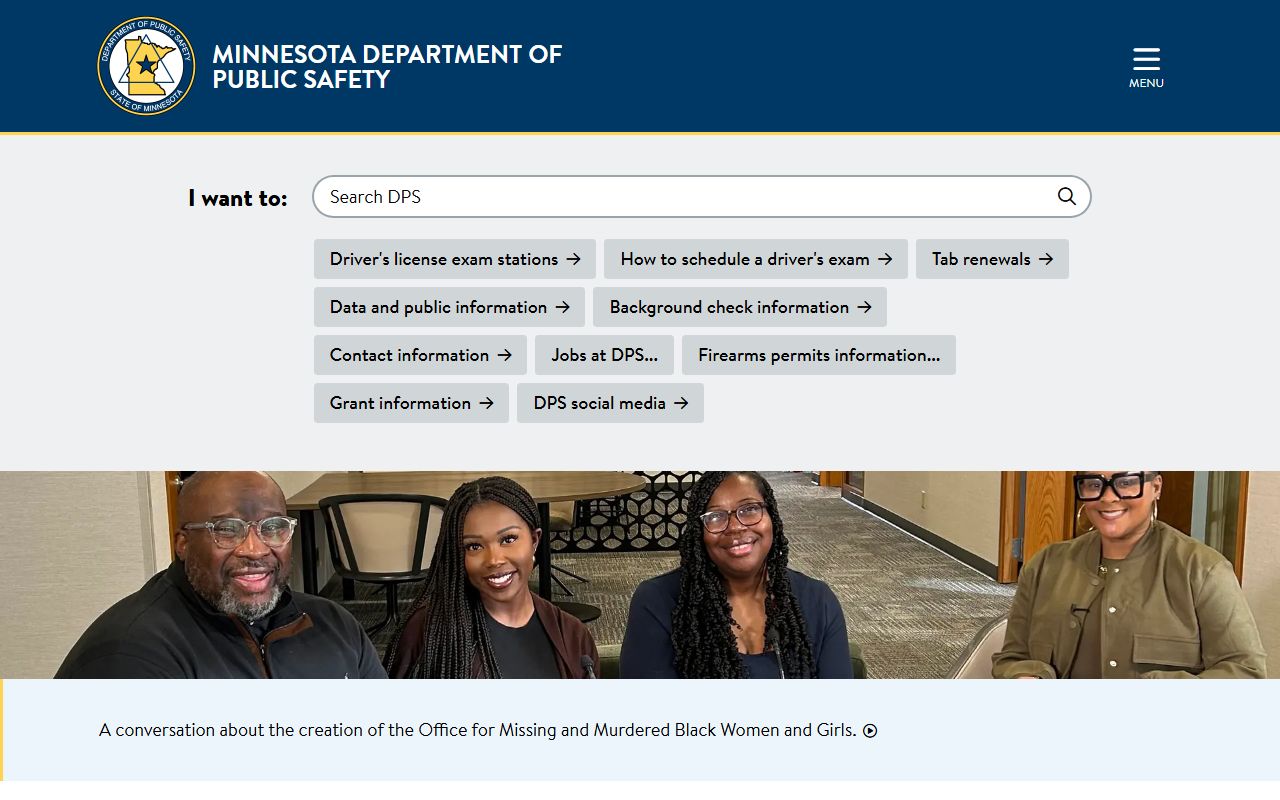
The DPS homepage links to the BCA, State Patrol, and other divisions that handle records requests.
The Minnesota Government Data Practices Act
The Minnesota Government Data Practices Act, known as the MGDPA, is the state law that governs access to all government records. It covers every level of state and local government, including law enforcement agencies. The MGDPA starts with a default rule: all government data is public unless a specific statute classifies it otherwise. Law enforcement data is one of the most detailed categories in the act.
The core provisions of the MGDPA are in several statutes. Minnesota Statute 13.025 lays out the basic framework and key definitions of the act. Minn. Stat. 13.03 covers the right to access public data and sets copy fee rules. Minn. Stat. 13.04 gives individuals rights to see and correct data about themselves. Minn. Stat. 13.05 governs how agencies must handle data practices compliance, including training and designating responsible authorities.
Every government entity must appoint a responsible authority. That person handles data requests and is the point of contact when you ask for records. Agencies must keep their records in a condition that makes them easy to access. They cannot bury data in hard-to-navigate systems as a way to prevent access.
The Minnesota Statute 13.025 page sets out the foundational structure of the Government Data Practices Act and how the act applies across state and local agencies.
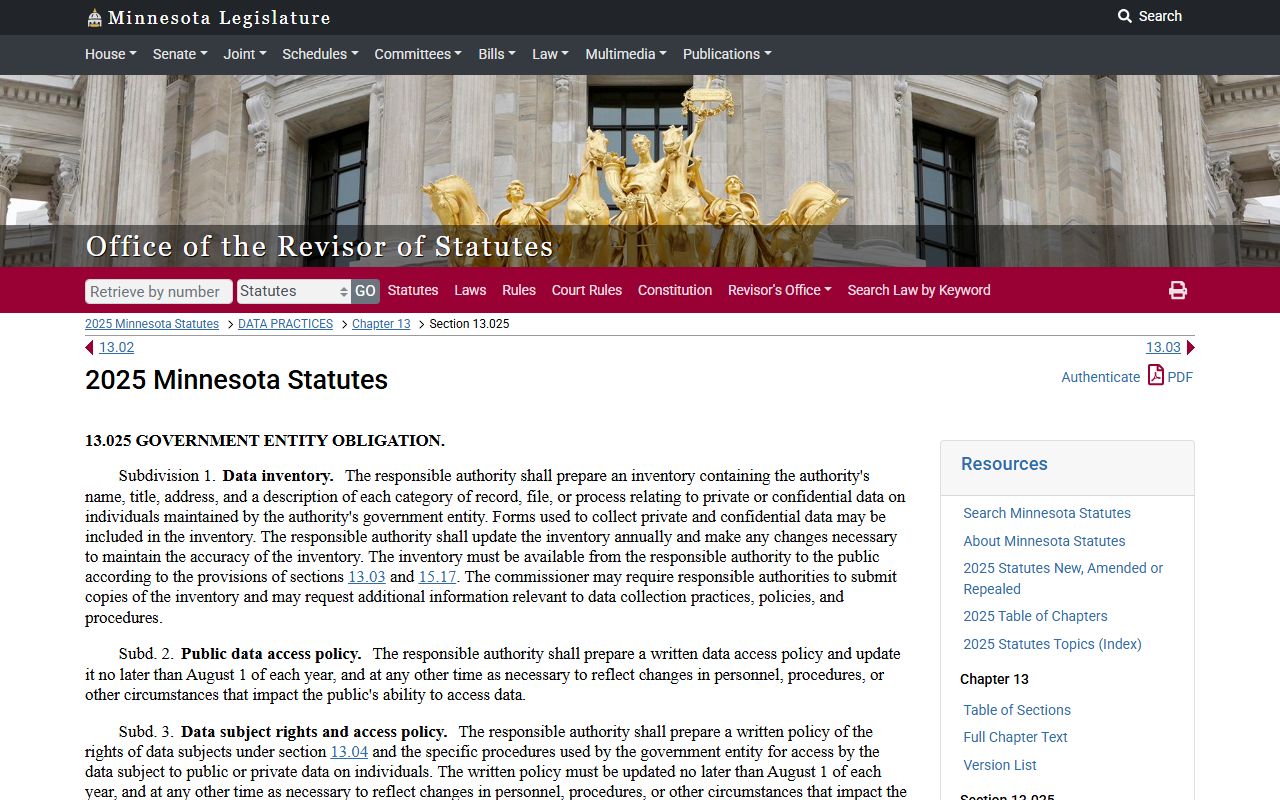
The statute defines key terms used throughout the MGDPA and establishes who must follow the act.
Compliance rules for agencies are in Minnesota Statute 13.05, which covers how entities must train staff, designate responsible authorities, and handle data requests properly.
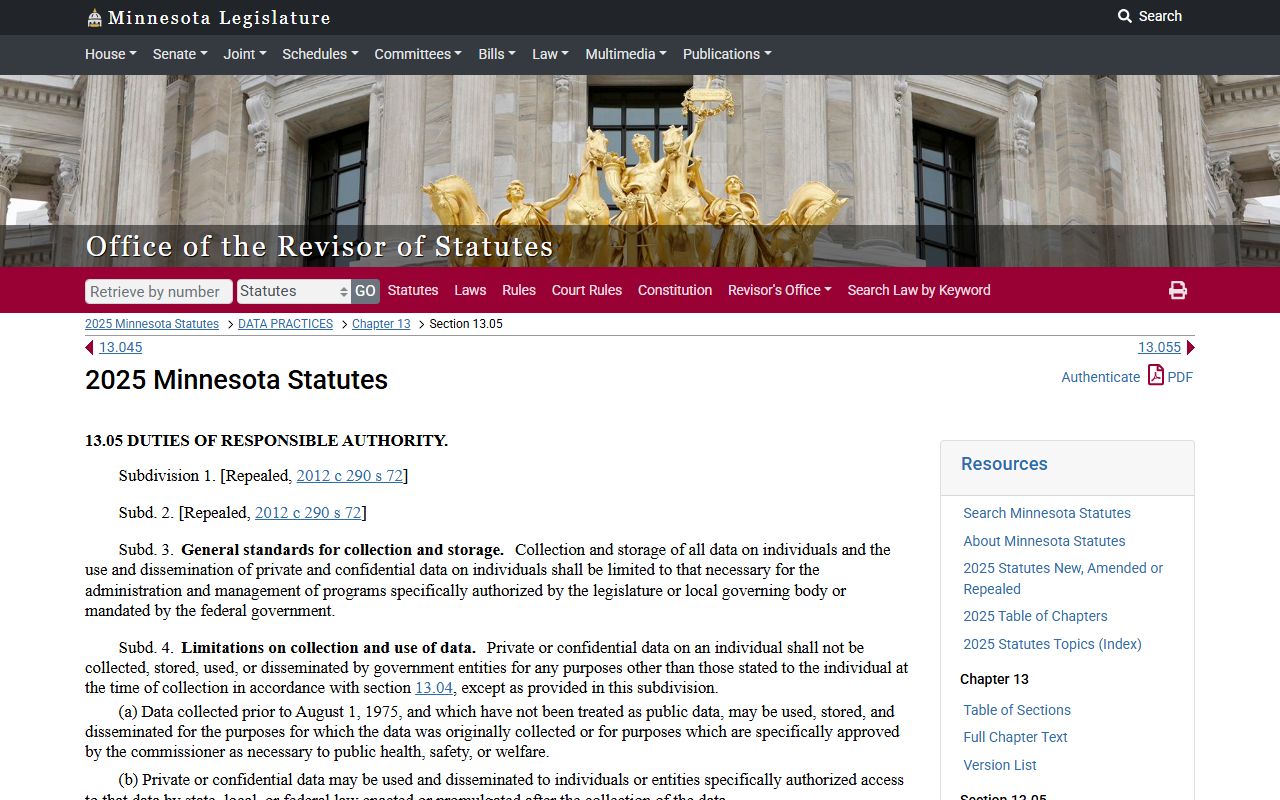
Agencies that fail to comply with data practices requirements can face penalties, and the state Office of Administrative Hearings handles disputes.
Criminal History Records and Predatory Offenders
Criminal history data in Minnesota is governed by Minnesota Statute 13.87. This statute defines what criminal history data is and classifies its different components. Criminal history data includes information about arrests, charges, convictions, and sentences. The BCA maintains the central system for this data and controls access based on the type of request and the requester’s legal authority.
Not all criminal history data is public. Some elements are private or confidential under Minn. Stat. 13.87. The BCA assigns each data element a classification based on state law. When you request a background check through the BCA, you get only the data you are authorized to receive under the statutes that apply to your situation.
The criminal history data statute at the revisor’s site shows exactly which elements are public and which are restricted.
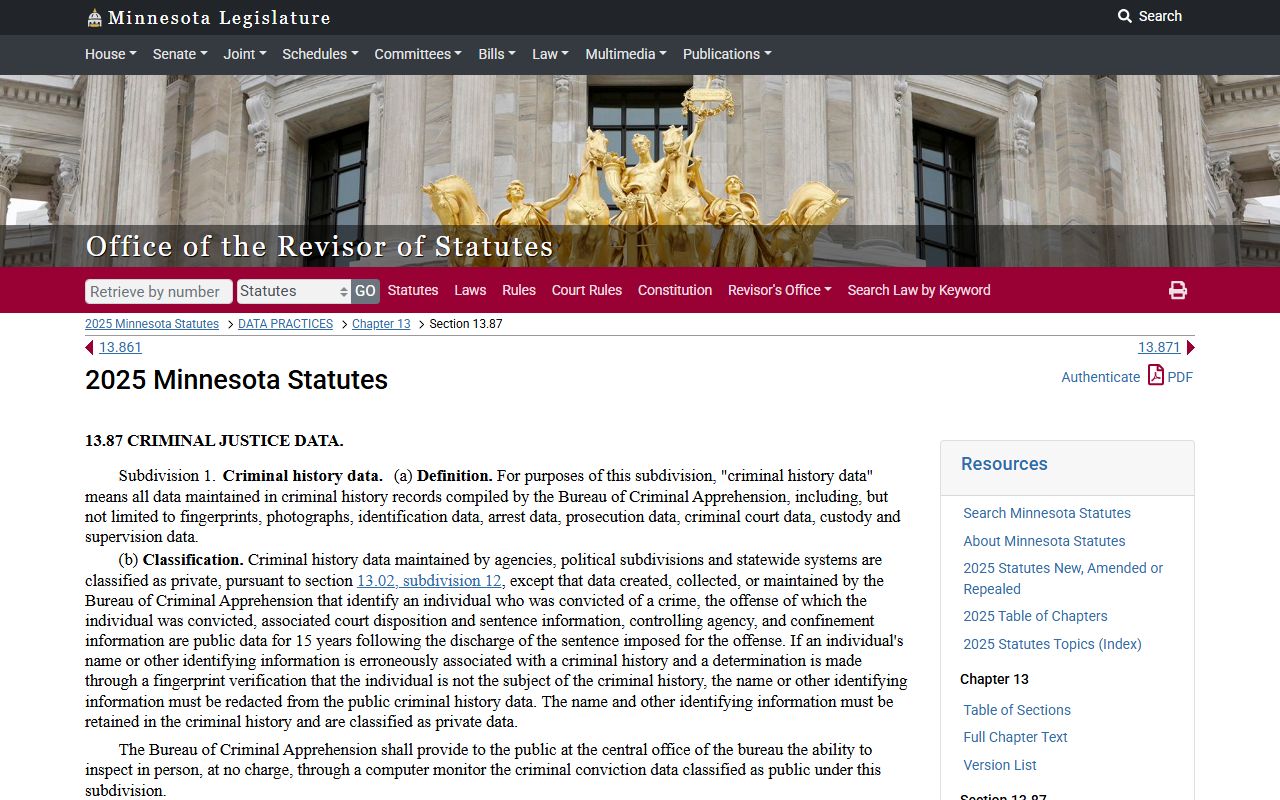
The statute applies to all agencies that collect or maintain criminal history data in the state.
Predatory offender registration is a separate public record category governed by Minnesota Statute 243.166. This law requires certain offenders to register their address with law enforcement after release. Some of the registration data is public. The BCA manages the statewide predatory offender registry.
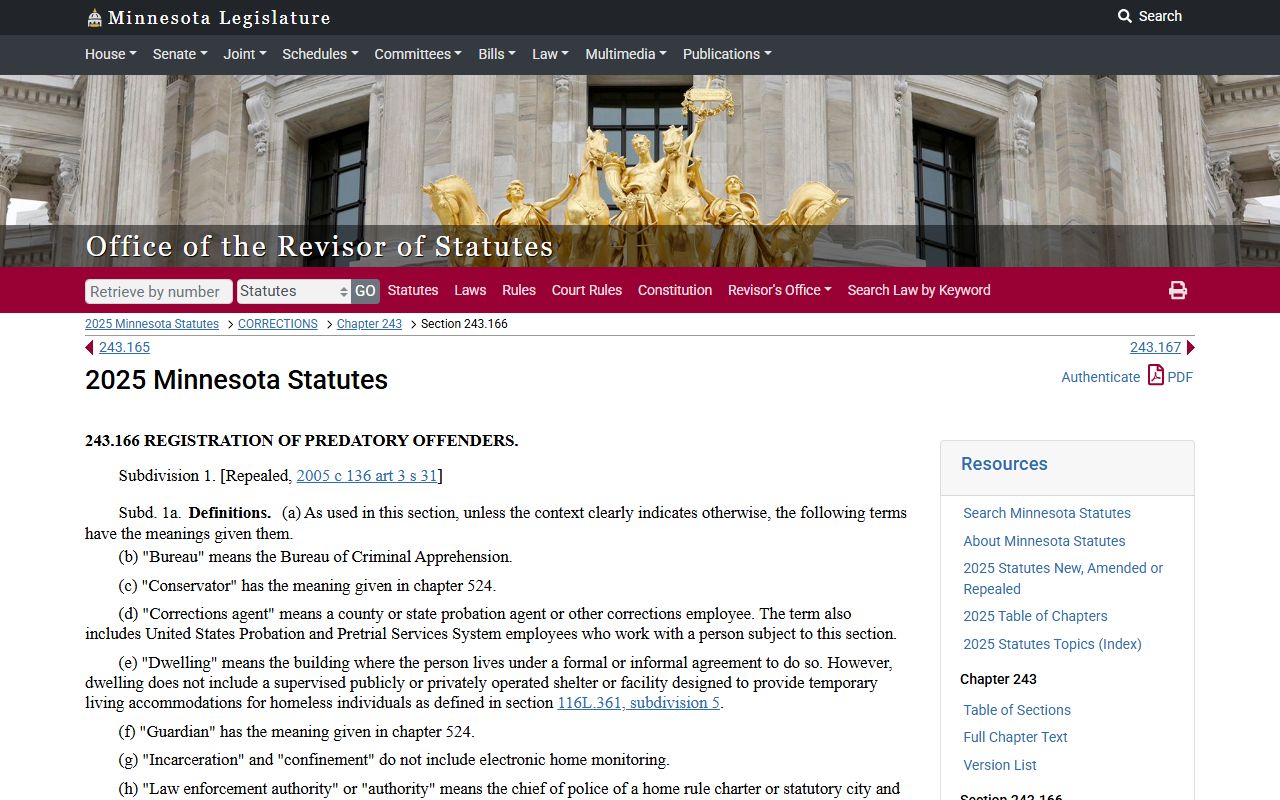
The registry is searchable through the BCA’s website at dps.mn.gov/divisions/bca.
Your Rights to Police Records in Minnesota
Every person has the right to inspect public government data at no charge. This means you can walk into any agency and ask to see public records without paying anything. The agency cannot require you to explain why you want the data. You don’t need to be a party to any case or have a direct connection to the event. The right to inspect is unconditional for public data.
If you are the subject of private or confidential data held by an agency, Minnesota Statute 13.04 gives you additional rights. You can ask any agency whether it has data about you and what classification that data carries. If data about you exists, you can see it and ask about its meaning. The agency must show you the data within 10 business days and provide copies at actual cost. After that, the agency does not have to repeat the showing for six months unless the data changes or a dispute is pending.
You can challenge data you believe is wrong. Under Minn. Stat. 13.04, subdivision 4, you notify the agency in writing about the error. The agency has 30 days to either fix the data or explain why it believes the data is correct. If the agency says it is correct and you disagree, you have 60 days to appeal to the state commissioner. The commissioner can try to resolve the dispute through conciliation or refer it to mediation before scheduling a formal hearing.
When an agency asks you to give them private or confidential data about yourself, it must first give you a Tennessen Warning. This written notice explains what the data is for, whether you are required to provide it, what happens if you refuse, and who else may receive it. The warning requirement protects your right to make an informed choice about sharing personal information with government agencies.
The Minnesota Statute 13.04 page at the revisor’s site has the complete text of data subject rights, including the Tennessen Warning requirement and the process for contesting inaccurate data.
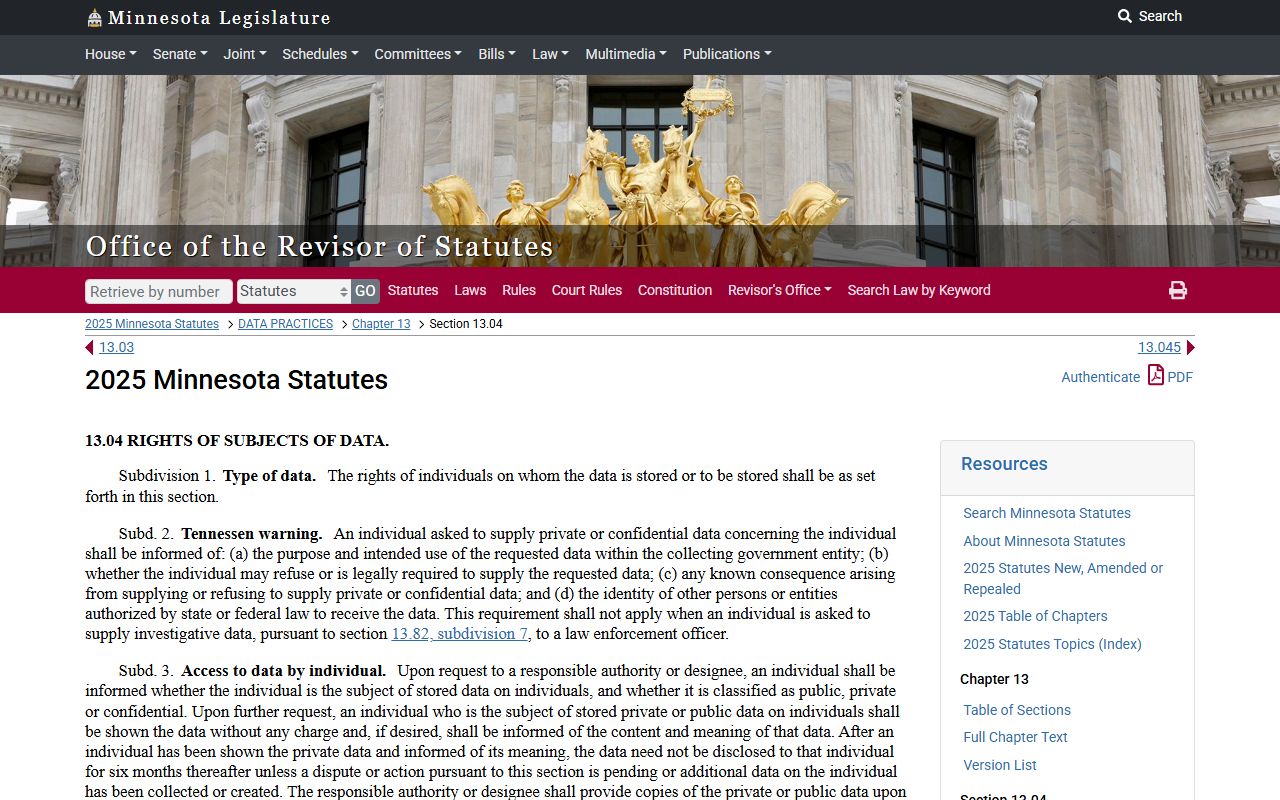
The statute gives individuals a clear process for seeing their own data and fixing errors, with defined timelines for every step.
Browse Minnesota Police Records by County
Each of Minnesota’s 87 counties has a Sheriff’s Office that keeps police records for incidents in unincorporated areas and for county law enforcement activities. Pick a county below to find local contact info, request procedures, and resources for police records in that area.
View All 87 Minnesota Counties
Police Records in Major Minnesota Cities
Residents of major cities in Minnesota can request police records directly from the city police department. Each city department has its own records unit, request process, and fee schedule. Pick a city below to find local details on getting police records in that area.